


Welcome to the eo-data-embedding documentation!#
Multi-modal geospatial embedding search & change detection on a frozen ViT foundation model.
eo-data-embedding turns Sentinel-1/2 imagery into reusable vector embeddings with a
frozen Clay v1.5 Vision Transformer. The heavy encoder pass runs once and is
persisted, so every downstream task — similarity search, few-shot classification and
change detection — runs cheaply over the stored vectors, with no per-task fine-tuning and
no GPU at query time. Reproducibility, honest evaluation and CPU/GPU portability are
first-class goals.
The problem it addresses: vast Earth-observation archives are hard to query and costly to label. A foundation-model embedding index makes an archive searchable (“find scenes like this”), lets a few-shot probe match a supervised CNN with far fewer labels, and exposes change between dates — all off one frozen encoder.
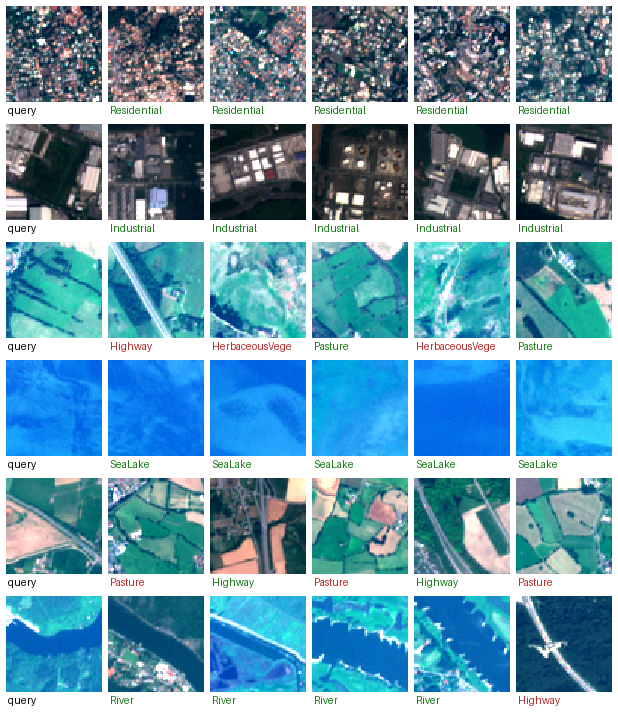
Similarity search on frozen Clay v1.5 embeddings: each query tile (left column) and its
nearest neighbours retrieved by FAISS cosine search (EuroSAT). See the
test report for the per-class retrieval, confusion-matrix and
label-efficiency figures, and the Software Verification Report
(compliance/drd/vv-report.md) for the full evaluation.#
Key results#
Embed once with a frozen Clay v1.5 Vision Transformer, then run every task over the stored vectors:
Similarity search — mAP@10 0.774, precision@10 0.822 (FAISS cosine).
Few-shot probe — macro-F1 0.895 ± 0.011 at 50 labels/class (0.92 on the full train pool) — the foundation-model label-efficiency benefit.
Change detection — supervised Δembedding F1 0.510, ROC-AUC 0.640 (honest, validation-chosen threshold; the zero-training distance method is rejected at chance and reported as such).
The numbers are reported honestly, including the negative results: see what the project does and why, the per-module design, and the scoped follow-on work (archive-scale index, time-series change detection) for where this goes next.
User documentation: