


Software unit and integration test report#
This page constitutes the Software unit and integration test report (SUITR) of the eo-data-embedding project.
Reports generated the 26/06/2026 00:11.
Test approach and levels#
Verification follows the project Verification & Validation Plan
(compliance/drd/vv-plan.md), which merges ECSS-E-ST-40C Annexes I/J/K and
applies the ML V&V discipline of ECSS-E-HB-40-02A. The dominant method is
test (T), executed automatically on every push and pull request, backed by
inspection (I) for the static quality gates.
Two test levels are exercised:
Unit — nine
tests/test_*.pymodules exercise eacheo_data_embedding/<module>.pyin isolation against deterministic, synthetic inputs. A sharedconftest.pyfixture seeds every randomised case (np.random.default_rng(0)) so runs are reproducible. Unit tests use no network and no datasets: the embedder is built withpretrained=False(random weights, no download) and the change/probe/search tests operate on in-memory NumPy/Torch tensors.Integration —
tests/test_phase0_smoke.pydrives the full synthetic pipeline end to end (encode → parquet store → FAISS → few-shot probe) by subprocess-runningscripts/phase0_smoke.py. It is marked@pytest.mark.slowand deselected by default; it runs explicitly withpytest -m slow. The CPU Docker image build is the second integration check: it proves the deployable artefact assembles with a CPU-consistent torch/torchvision ABI.
Test suite and CI#
The suite comprises nine test modules plus a shared conftest.py:
Test module |
Module(s) under test |
REQ |
|---|---|---|
|
|
REQ-F-01 |
|
|
REQ-F-01 |
|
|
REQ-F-02 |
|
|
REQ-F-03, REQ-N-02 |
|
|
REQ-F-04 |
|
|
REQ-F-04 |
|
|
REQ-F-05, REQ-N-02 |
|
|
REQ-N-01 |
|
full pipeline via |
REQ-F-06 (integration) |
CI runs two sequential jobs on push/PR to main: lint-test (Python 3.11)
installs CPU-matched torch/torchvision, then runs ruff check,
ruff format --check and pytest (slow deselected); docker-cpu
(needs: lint-test) builds the deployable CPU image.
Pass criteria#
A change is verified when, on the pull request: (1) ruff check and
ruff format --check report no findings; (2) pytest (default,
slow-deselected) exits 0; and (3) the CPU Docker image builds. The slow
integration smoke asserts a clean exit (returncode == 0) for the Phase-0
script. The ML-validation discipline additionally requires held-out split
integrity (no leakage), validation-chosen thresholds, and honest reporting of
negative results — see the Results section below.
Results#
The figures below are the published, validation-chosen operating points from
the Software Verification Report (compliance/drd/vv-report.md); thresholds
are calibrated on held-out validation slices of the train split, never swept on
the evaluation set.
Metric |
Value |
Requirement |
Status |
|---|---|---|---|
Similarity retrieval — mAP@10 |
0.774 |
REQ-F-03 |
Verified |
Similarity retrieval — precision@10 |
0.822 |
REQ-F-03 |
Verified |
Few-shot linear probe — macro-F1 @ 50 labels/class |
0.895 ± 0.011 |
REQ-F-04 |
Verified |
Few-shot linear probe — macro-F1 @ full train pool |
0.920 |
REQ-F-04 |
Verified |
Change detection (tile) — F1 |
0.510 |
REQ-F-05 |
Partially verified |
Change detection (tile) — Cohen’s Kappa |
0.231 |
REQ-F-05 |
Partially verified |
Change detection (tile) — ROC-AUC |
0.640 |
REQ-F-05 |
Partially verified |
Negative / honest findings. Zero-training change detection (cosine distance
between the two dates’ frozen embeddings) scores at or below chance (ROC-AUC
0.27–0.49 across every configuration) and is recorded as rejected by
experiment, with the seasonality/phenology confound traced as the root cause.
The frozen-foundation-model thesis survives via the cheap supervised Δembedding
probe (ROC-AUC 0.640, F1 0.510), reported with its honest, validation-chosen
threshold. Line/branch coverage is currently unmeasured (pytest-cov not
yet wired into CI), recorded as the open gap REQ-N-05 (≥ 70 %).
Result figures#
The figures below are regenerated from the public demo bundle
(embeddings.parquet + probe.npz, a 2,000-tile EuroSAT subset) and
illustrate the methodology end to end. They reproduce the published behaviour on
the subset; the headline numbers in the table above are the full evaluation from
the Verification Report (minor differences are expected on the smaller subset).
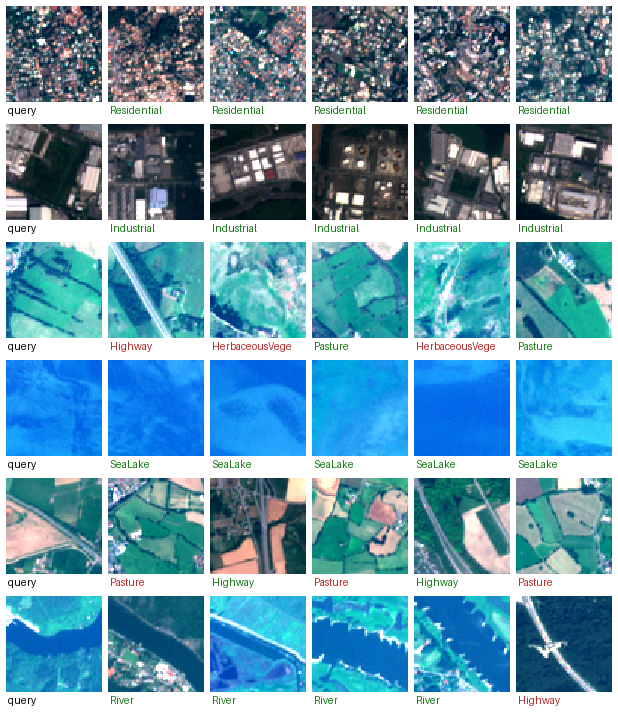
Similarity search on frozen Clay v1.5 embeddings: each query tile (left
column) and its nearest neighbours retrieved by FAISS cosine search
(IndexFlatIP), with EuroSAT class labels.#
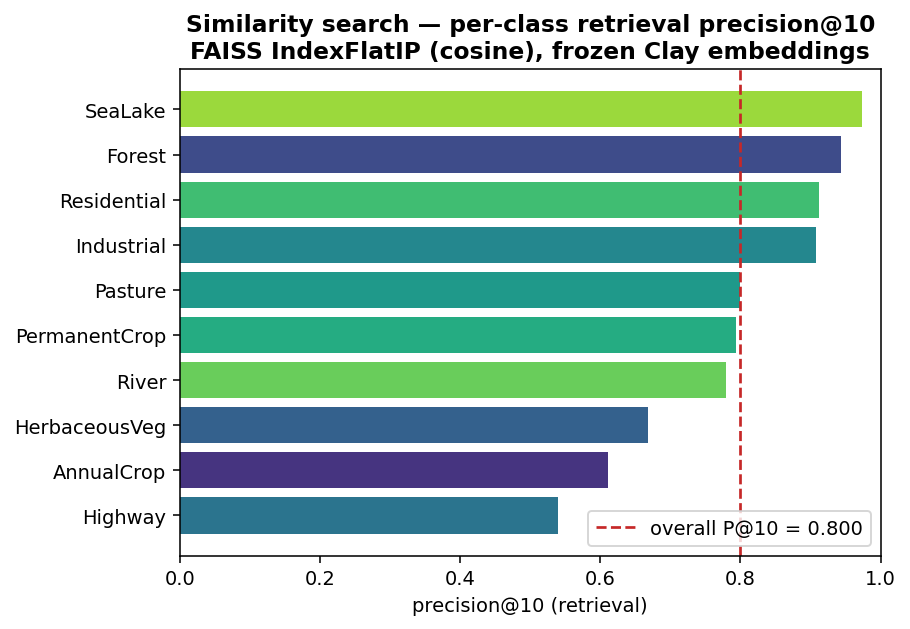
Per-class retrieval precision@10 on the demo-bundle held-out queries (overall P@10 = 0.80 on this subset; full-evaluation figure 0.822).#
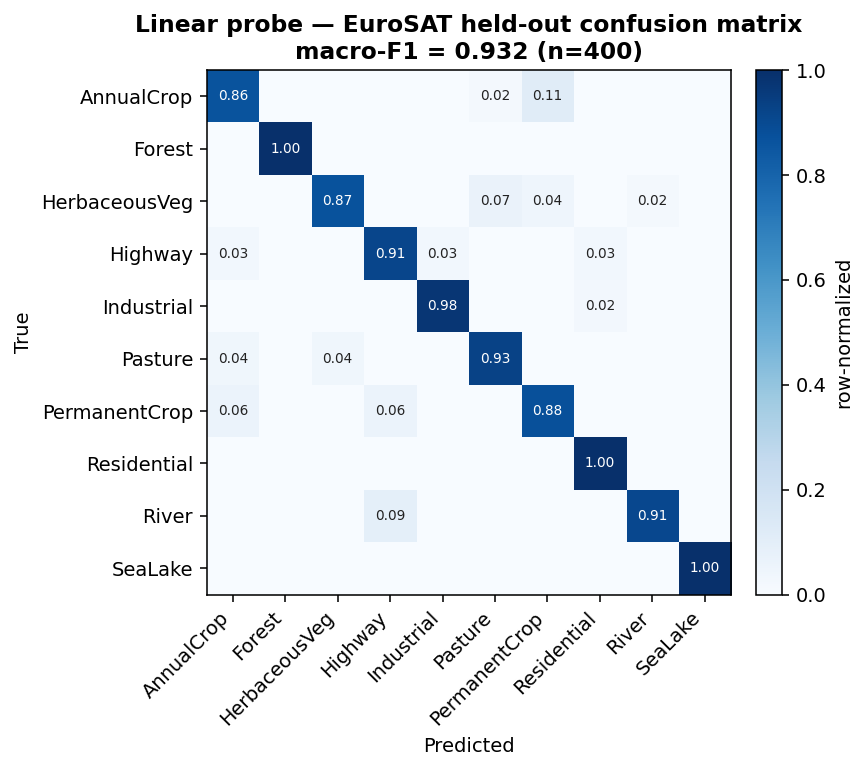
Few-shot linear-probe confusion matrix on the demo-bundle held-out split (row-normalized). Errors concentrate on the spectrally similar AnnualCrop / HerbaceousVegetation / PermanentCrop group.#
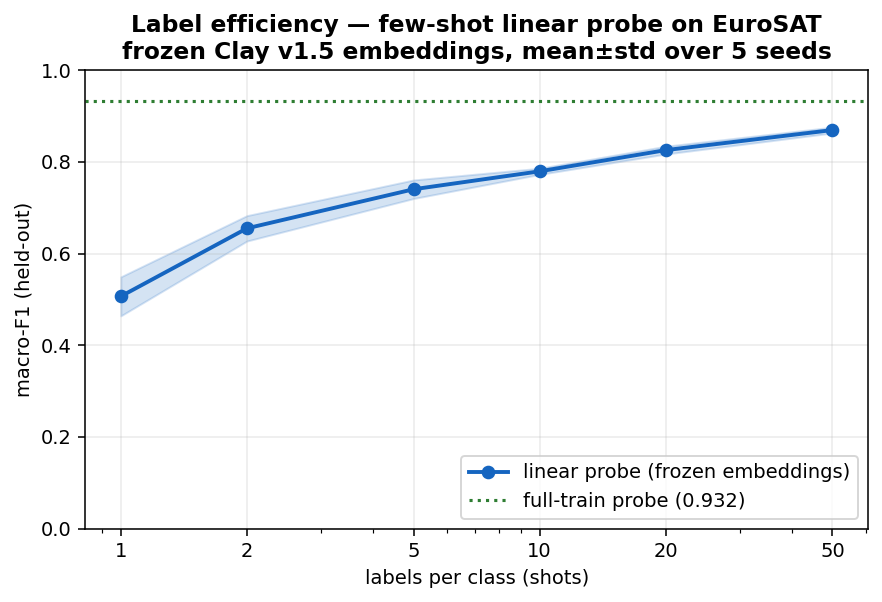
Label efficiency — the foundation-model value proposition: a linear probe on frozen embeddings reaches a strong macro-F1 with only a handful of labels per class and approaches the full-train probe (mean ± std over 5 seeds).#
Test report annexes#
The generated machine-readable reports below are produced by the CI pipelines.