


Results#
Products of the real processing chain, with per-band quality statistics and their reading. Two validated end-to-end runs back this page; both consume the Sentinel-2 MSI Synthetic Raw Data Generator’s products as input.
L0 → L1B — real chain, persisted product#
The generator’s open-container L0 + calibration-database ADFs pushed through
l0_decode → radiometric → enhancement → toa (eopf == 2.8.1, nominal mode,
emit_reflectance): a persisted L1B TOA-reflectance EOPF product.
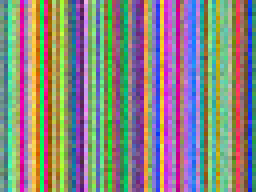
L1B TOA reflectance, RGB = B04/B03/B02, per-channel 2–98 % percentile stretch. The demo scene is a flat field, so the stretch deliberately reveals the residual texture: per-column striping is the impressed PRNU pattern, the speckle is shot/read noise.#
Per-band statistics (the pipeline’s stats phase, the non-referential ALG-QA metrics
of msi_processor/common/metrics.py — SDD <5.4.1>; produced by the manual
product-stats CI job, 2026-07-02):
Band |
mean (reflectance) |
std |
variance |
SNR (dB) |
|---|---|---|---|---|
B02 |
0.1753 |
0.0053 |
0.000029 |
30.3 |
B03 |
0.1888 |
0.0066 |
0.000044 |
29.1 |
B04 |
0.1911 |
0.0070 |
0.000049 |
28.7 |
B08 |
0.2648 |
0.0094 |
0.000089 |
29.0 |
B11 |
0.0434 |
0.0017 |
0.000003 |
28.3 |
B12 |
0.0535 |
0.0019 |
0.000004 |
28.8 |
Reading the numbers#
Reflectance means sit at the levels impressed by the generator’s flat-field scene (≈ 0.19 VNIR / 0.27 NIR / 0.05 SWIR) — the absolute radiometric scale survives the full chain (DN → radiance → reflectance) unchanged.
SNR is scene-limited, not instrument-limited: on a flat field the standard deviation is the residual instrument texture (uncorrected PRNU + noise), so the per-band SNR ranks the bands by their noise-model α/β and PRNU amplitude.
Variance complements SNR as the raw second moment used by the QA stage (
ALG-QA-*); both are computed product-side with no reference.
Validation status#
The chain producing these numbers is CI-verified: 8 of 8 processing units implemented and green (see the SUITR and the live CI test report).
A second, sharper end-to-end result — the real-L1A bit-identity run through
l0_decode(L1A′ ≡ L1A, 13/13 bands) — is documented in the generator’s validation pages and its qualification is summarised in the QR report.AR-gated figures: the referential accuracy metrics (L1B radiometric RMSE vs a calibrated reference — REQ-P-01
RAD_ACC; geometricGEO_CE90/BAND_COREG— REQ-P-02;BOA_ACC— REQ-P-03) are validated on operator data at AR and are deliberately not quoted here (see the V&V report). thestatsphase computes them once a reference product is available.
Reproduce#
Run the manual pipeline-nominal CI job (integration-tests stage): the repository’s
single driver pulls the inputs from the shared ipf/data-store registry, runs
l0-decode → radiometric → enhancement → toa → stats and artifacts the statistics
table. Locally (eopf environment): python scripts/run_pipeline.py <store>;
--mode calibration derives and cross-validates the NUC instead.